Tuesday, November 9, 2021

" Seizing Everything: The Theft of the Global Commons – Part 2" by Iain Davis


Seizing Everything: The Theft of the Global Commons – Part 2

Iain Davis
The population problem has no technical solution; it requires a fundamental extension on morality.”
Garret Hardin, “The Tragedy of the Commons”

In Part 1 we explored the ongoing process of defining of the global commons and the claim of the stakeholder capitalists they they should be the “trustees” both of the commons and society. We are now going to look at how systems have been established to enable those stakeholders to seize them.

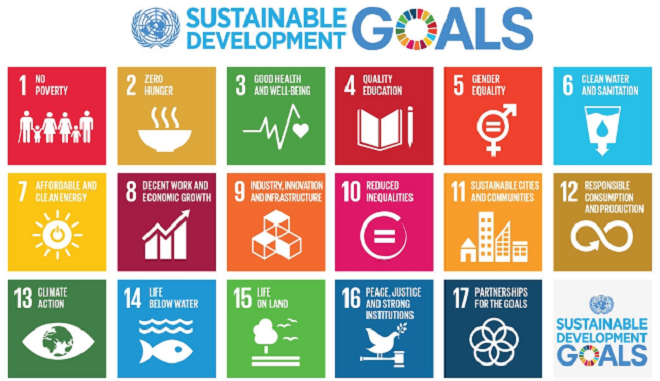
We should be mindful of what “global commons” means for the Global Public Private Partnership (GPPP). For them it means possession of everything: every resource on the planet, all land, all water, the air we breath and the natural world in its entirety, including all of us.

Principles of the Global Commons

The notion of the “global commons” sprang from an amalgam of two principles in International Law. The Tragedy of The Commons (ToC) and the Common Heritage of Mankind (CHM).

In his 1968 paper on the ToC, the U.S. ecologist and eugenicist Garrett Hardin, building upon the earlier work of the 19th century economist William Forster Lloyd, outlined the population and resource problems as he saw them. He said “a finite world can support only a finite population; therefore, population growth must eventually equal zero.”

While logically this is ultimately true, if a whole raft of assumptions are accepted, the point at which zero population growth becomes necessary is unknown. The evidence suggests we are nowhere near that limit. Eugenicists, like Hardin, have claimed and continue to claim that the Earth faces a population problem. There is no evidence to support their view.

Hardin theorised that when a resource, such as land, is shared in “common,” people acting in rational self-interest will tend to increase their use of that resource because the cost is spread among all. He called this type of thinking a tragedy because, if all act accordingly, he maintained that the resource would dwindle to nothing and everyone suffer as a result.

Hardin insisted that this tragedy could not be averted. Therefore, as human beings were, in his eyes, incapable of grasping the bigger picture, the solutions were “managed” access to resources and “population control.”

While Hardin’s elitist ToC concept suggested regulated, enclosed (private) access to “common” resources, the Common Heritage of Mankind (CHM) rejected the idea of enclosure (privatisation). CHM instead advocated that a special group should be created by international treaty as “trustees” of the global commons. Seen as more “progressive,” it was no less elitist that Hardin’s concept.

The philosophical concept of CHM emerged onto the global political stage in the 1950’s but is was the 1967 speech by the Maltese ambassador to the U.N., Arvid Pardo, which established it as a principle of global governance. This eventually led to the 1982 U.N. Convention on Law of the Sea (LOSC).

Citing the CHM, in Article 137(2) of the LOSC, the U.N. declared:

All rights in the resources of the Area are vested in mankind as a whole, on whose behalf the Authority shall act.”

That “Area”, in this case, was the the Earth’s oceans, including everything in and beneath them. The “authority” was defined in Section 4 as the International Seabed Authority (ISA). Article 137(2) of the LOSC is self contradictory.

The legal definition of “vested” implies that the whole of humanity, without exception, has an absolute right to access the global commons. In this instance, those commons were the oceans. While the legal definition speaks of ownership, “vested” seems to guarantee the no one can lay any individual claim to ownership of the oceans or its resources. Access is equally shared by all.

Supposedly, this alleged right can never be “defeated by a condition precedent.” This is repudiated entirely by “on whose behalf the Authority shall act.”

Who among the billions of Earth’s inhabitants gave the ISA this alleged authority? When were we asked if we wanted to cede our collective responsibility for the oceans to the ISA?

This authority was seized by U.N. diktat and nothing more. It is now the ISA who, by a condition precedent, control, limit and license our access to the oceans.

This is the essential deception at the heart of GPPP’s “global commons” paradigm. They sell their theft as stewardship of the resources vested in all humanity, while simultaneously seizing the entirety of those resources for themselves.

Seizing The Global Commons: The Oceans

When interpreted by International Law, the CHM appears to place the private ownership of the global commons, suggested by the ToC, beyond the reach of government stakeholder partners. They should have no more right to these riches than anyone else. Legal challenge to any claim should be a relatively straight forward process for any concerned individual or group minded to make one.

This is not even a remote possibility. International Law, as it pertains to the global commons, is a meaningless jumble of inconsistencies and contradictions that ultimately amounts to “might is right.” For anyone to challenge the GPPP’s claim they would need to retain a legal team capable of defeating the UN’s and a judiciary willing to find in their favour.

The “law” is ostensibly designed to leave us imagining that we have “protected” rights and responsibilities towards these shared resources. Whereas, if subjected to any reasonable scrutiny, the legal notion of the global commons looks more like a diversion to facilitate a robbery.

If we look at the ISA’s record of stakeholder engagement we quickly find their Strategic Plan for 2019 – 2020. This succinctly outlines how the scam operates:

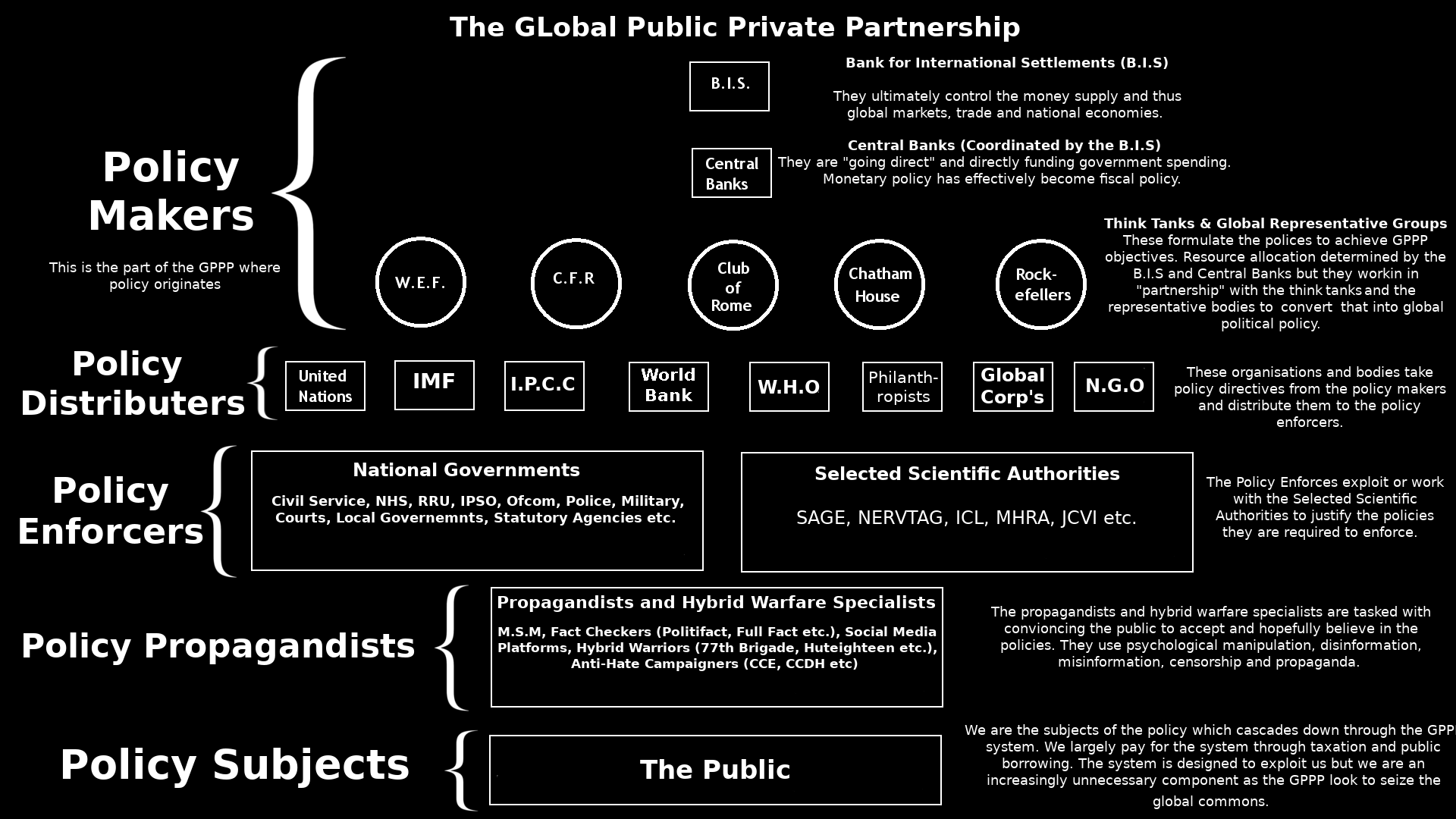
In an ever-changing world, and in its role as custodian of the common heritage of mankind, ISA faces many challenges…The United Nations has adopted a new development agenda, entitled ‘Transforming our world: the 2030 Agenda for Sustainable Development.’[…] Of most relevance to ISA is SDG 14 — Conserve and sustainably use the oceans, seas and marine resources.”

The shared resource – global commons – of the Earth’s oceans are not freely accessible to humanity as a whole anymore. Rather, the ISA determine who gets access to oceanic resources based upon Sustainable Development Goals (SDGs). Effectively they have turned access to the global commons into a new market.

The most vital questions we must ask is how these allocation decisions are made and by whom. This will reveal who controls these new highly regulated markets. The ISA state:

States parties, sponsoring States, flag States, coastal States, State enterprises, private investors, other users of the marine environment and interested global and regional intergovernmental organizations. All have a role in the development, implementation and enforcement of rules and standards for activities in the Area”

In addition, the ISA will:

Strengthen cooperation and coordination with other relevant international organizations and stakeholders in order to…effectively safeguard the legitimate interests of members of ISA and contractors…The rules, regulations and procedures governing mineral exploitation…are underpinned by sound commercial principles in order to promote investment…taking into account trends and developments relating to deep seabed mining activities, including objective analysis of world metal market conditions and metal prices, trends and prospects…based on consensus…that allows for stakeholder input in appropriate ways.”

The Global Public Private Partnership (GPPP) of governments, global corporations (other users of the marine environment), their major shareholders (private investors) and philanthropic foundations (private investors) are the stakeholders. They, not us, will have an input to ensure the rules, regulations and procedures will promote investment that will safeguard their interests.

In the space of a few short decades, broad concepts have evolved into principles of International Law which have subsequently been applied to create a regulatory framework for controlled access to the all the resources in the oceans. What was once genuinely a global resource is now the sole province of the GPPP and its network of stakeholder capitalists.

The Global Commons Are Global

We should be wary of falling into the trap of thinking the GPPP comprises solely of the western hegemony. The stories we are fed about the global confrontation between superpowers are often superficial.

While there are undoubtedly tensions within the GPPP, as each player jostles for a bigger slice of the new markets, the GPPP network itself is a truly global collaboration. This doesn’t mean that conflict between nation states is impossible but, as ever, any such conflict will be fought for a reason absent from the official explanation.
[click to enlarge]

SDG’s led to net zero policies and they stipulate, among a swath of enforced changes, the end of petrol and diesel transport. We are all under orders to switch to electric vehicles (EVs) which the vast majority won’t be able to afford. In turn, this means a massive increase in demand for lithium-ion batteries.

Manufacturing these will require a lot more cobalt which is widely considered to be the most critical supply chain risk for producing EVs. The World Bank estimate that the growth in demand for cobalt between 2018 and 2050 will be somewhere in the region of 450%. To say this is a “market opportunity” is a massive understatement.

The ISA have granted 5 cobalt exploration contracts to JOGMEC (Japan), COMRA (China), Russia, the Republic of Korea and CPRM (Brazil). When located deposits become commercially viable, as they undoubtedly will, the corporate feeding frenzy can begin.

Corporations, such as the weapons manufacturer Lockheed Martin, with its wholly owned subsidiary UK Seabed Resources (UKSR), are also among the many ISA stakeholders. UKSR received their exploration license for the South Pacific in 2013. As an ISA exploration contractor, UKSR stakeholders are free to submit their recommendations for amendments to the ISA regulations governing their own mining operations.

For example, the ISA stated that mining corporations should provide a financial guarantee that would cover “unexpected costs, expenses and liabilities.” Lockheed Martin didn’t like this at all and so suggested a slight change. They recommended the addition of the following:

The Guarantee is not to cover costs, expenses and liabilities incurred as a result of tortious liability for environmental damage.”

This was presumably because, in their pursuit of SDG “protection” of the planet, Lockheed Martin don’t wish to be liable for the environmental damage they will inflict upon it in the process. This risk of this is high because the proposed method for “scraping the seabed” will almost certainly destroy it.

Fortunately for UKSR and other stakeholders like COMRA, the ISA’s is committed to regulations which promote sound commercial principles and safeguard their commercial interests. Destroying the seabed is a risk worth taking but not if you have to pay for it.

When it comes to fighting climate change, human life is even cheaper. Nearly all cobalt is currently mined from Africa’s copper belt and more than 60% of the world supply comes from the Democratic Republic of the Congo. It is clawed from the Earth by tens of thousands of child slaves.

This poisonous torture dramatically shortens the abject misery of their suffering on this Earth. However, it does mean other young people like Greta Thunberg can inspire more fortunate children to mobilise on social media, using their fully charged devices, to save the planet.

Only the commercial viability of deep-sea reserves seems capable of saving the cobalt mine slaves. Alas, it is difficult to envisage how deep see reserves will become viable until land based reserves near exhaustion.

This openly condoned child abuse has been ongoing for years. A fact which the world’s media admits but never mentions when it eulogises about the green revolution.

The estimated 94,000 tonnes of cobalt in the Clarion Clipperton Zone (CCZ) of the Eastern Pacific alone represents 6 times the known land based reserves. With total deep sea reserves estimated to be worth between $8 – $16 trillion, as we progress towards a carbon neutral economy, deep sea mining is an inevitability. Regardless of the environmental cost.

All the real environmental issues are to be ignored as the world embarks upon a transition to a new global economy based upon one highly questionable theory: namely anthropogenic global warming (AGW).

The Global Commons New Market(s)

This transition to the green economy will see myriad new markets created as the Earths “common” resources are converted into proverbial investment gold mines. Cobalt scraped from the seabed is just one example, there are thousands more.

The GPPP will have exclusive access, and thus control, over these new, essential resources. The investment opportunities are endless. It is this prospect, not any concerns for the Earth or humanity, that is driving the seizure of the global commons.

The GPPP have recognised that if they can squeeze something into the “global commons” they can then control of it. Consequently, the list of alleged “commons” continues to grow, as the the GPPP seek more control over more of the planet and everything on it.

In 1996 the late John Perry Barlow, from the Electronic Freedom Foundation, presented a Declaration for the Independence of Cyberspace to the annual Davos conference of the World Economic Forum (WEF). It perhaps seems odd that the GPPP wanted to hear this radical, libertarian call for governments around the world to leave cyberspace unregulated.

However, as I stress in my book Pseudopandemic, the intent of ideas, political and economic philosophies or social doctrines is not what interests the GPPP. Rather, it is how those ideologies can be exploited to achieve their goals.

In making his address Barlow was, perhaps inadvertently, laying the groundwork to include cyberspace as part of the “global commons.” 

As we shall discuss shortly, the GPPP already had a plan in place to appropriate everything defined as a global commons. It was this prospect which enthralled the assembled Davos (GPPP) crowd.

In their 2015 Davos executive summary the WEF illustrated how the GPPP manipulate narratives to reshape the context of our daily lives.

In this case, the objective was to institute the precepts for their claimed jurisdiction of cyberspace.

What is clear is that we are confronted by profound political, economic, social and, above all, technological transformations.. resulting in an entirely ‘new global context’ for future decision-making…The World Economic Forum’s Annual Meeting provides an unparalleled platform for leaders to develop the necessary insights, ideas and partnerships to respond to this new context…

Based on the principle that a multistakeholder, systemic and future-oriented approach is essential in this new context, the issues to be addressed through sessions, taskforces and private meetings at the Annual Meeting 2015 include…The inability to significantly improve the management and governance of critical global commons, most notably natural resources and cyberspace.

We have considered the example of the oceans and their resources, but the process for creating a regulated markets for all commons is the same. First something must be levered into the category of the global commons. Once declared to be among the “shared resources all life relies upon,” some GPPP quango is appointed to oversee access to the new regulated market.

This body will be formed to serve the stakeholders capitalists who will then have exclusive access to and control of that resource.

In accordance with the U.N. definition “stewardship of the global commons cannot be carried out without global governance.” Global governance is formally convened via the process of stealing the global commons. The entire operation is founded upon sustainable development.

The Agendas For Sustainable Global Commons

As mentioned previously, this plan has been in-place for decades. Sustainable Development Goals (SDGs) are set in Agenda 2030 as way-points along the path to completion of the plan for the 21st century: Agenda 21.

When GPPP stakeholders say they are committed to SDG’s they mean Agenda 2030, in the short term, and ultimately Agenda 21. Agenda 21 has a lot to say about what it calls “human settlements.” It lays out how they will be planned, constructed and managed by a public-private partnership. However, in constructing human settlements, human beings do not appear very high on the priority list.

Objective 5.29 states:

In formulating human settlements policies, account should be taken of resource needs, waste production and ecosystem health.”

Resource allocation, waste management and environmental protections are the prerequisites for “human settlements.” Not the welfare of humanity.

The GPPP will oversee the construction or allocation of our settlements. Objective 7.30. d. states:

Encourage partnerships among the public, private and community sectors in managing land resources for human settlements development.”

All land, not just the commons, will be managed by the GPPP. Again, subsequent Agenda 2030 SDGs have provided the justification for the land grab.

Objective 10 of Agenda 21 states:

The broad objective is to facilitate allocation of land to the uses that provide the greatest sustainable benefits and to promote the transition to a sustainable and integrated management of land resources”

Clearly this raises issues of private land ownership and use. Not just among householders but by industry, farmers, train companies or any other private land owner. The trick in holding on to land will be to secure its designation as having a “sustainable” purpose. This allocation will need to be agreed by the GPPP, so friends in high places will be key.

Agenda 21 demands, under “Activities” in section 7.29, that all nations must develop:

A comprehensive national inventory of their land resources in order to establish a land information system in which land resources will be classified according to their most appropriate uses and environmentally fragile or disaster-prone areas will be identified for special protection measures.”

If the place where you live is deemed to be environmentally fragile, and we are told the whole planet is, then the GPPP will follow section 7.30. h and implement:

Practices that deal comprehensively with potentially competing land requirements for agriculture, industry, transport, urban development, green spaces, preserves and other vital needs.”

This will involve the creation of “protected areas.”  Among many of their authoritarian powers, this means that the GPPP will have control of all drinking water. Water sources automatically become “protected areas” under Agenda 21, for the good of our “health.”

Activity 18.50 it states:

All States, according to their capacity and available resources, and through bilateral or multilateral cooperation, including the United Nations and other relevant organizations as appropriate, could implement the following activities:.. Establishment of protected areas for sources of drinking-water supply.”

By exploiting the deception of “sustainable development” a planetary system of global governance, under the auspices of the GPPP, is currently being established. This is “build back better,” the “Great Reset,”  the “Green New Deal” or whatever the GPPP choose to sell it as.

It means GPPP dominion over absolutely everything. We truly will own nothing, although it seems unlikely that many of us will be happy about it.
Those who do not understand, or do not wish to admit the reality of this global coup d’état, are quick to point out that Agenda 21 – and 2030 – are not legislation. Nation-states are not compelled to go along with any of it. This observation fails to appreciate what “global governance” is.

Global governance is not the setting of either policy or legislation. It is the creation of policy agendas which individual nation states may or may not implement as policy or subsequent legislation. It can only have teeth if nation states comply.

The problem we face is that nation states are “partner organisation,” some might say junior partners, within the GPPP. While they remain sovereign entities they do not act as such. We only need look at how global markets are created by Agenda 21 to see how all nation states have willingly collaborated in the sustainable development scam.

In Agenda 21 the declared “Basis for Action” at section 8.41 states:

A first step towards the integration of sustainability into economic management is the establishment of better measurement of the crucial role of the environment as a source of natural capital.. A common framework needs to be developed whereby the contributions made by all sectors and activities of society, that are not included in the conventional national accounts, are included.. A programme to develop national systems of integrated environmental and economic accounting in all countries is proposed.”

The clearly stated plan, written in 1992, was to create “natural capital” to shift “sustainability into economic management.” All sectors and all society will be involved in this effort to transform nature into economic capital.

This will include the  oversight of the “activities of society,” such as our use of cyberspace, which are “not included in the conventional national accounts.” The global commons in other words.

It doesn’t matter if Agenda 21 (2030) has legislative authority or not. All the matters is the complicity of legislative authorities. They are in full compliance.

Agenda 21 proposed the development of “national systems of integrated environmental and economic accounting in all countries.” This was envisaged to complete the transformation of the Earth and all of its natural resources into a centralised system of economic control.

As Whitney Webb explored in her excellent article, Wall Street’s Takeover of Nature Advances with Launch of New Asset Class that is precisely what has happened. By once again misusing the concept of the global commons, the GPPP has created Natural Asset Companies (NACs). These will allegedly:

Preserve and restore the natural assets that ultimately underpin the ability for there to be life on Earth.”

This allusion to caring for the global commons all sounds wonderful but when we consider its impact upon the oceans depths, for example, it is really just the creation of new markets. Concern for environmental destruction barely registers.

The Metrics of the Global Commons

Clearly, the objective of NACs is to secure GPPP stakeholder’s exclusive access to resources which, hitherto, weren’t “owned” by anyone. Michael Blaugrund, the Chief Operating Officer of the New York Stock Exchange, admitted as much:

Our hope is that owning a natural asset company is going to be a way that an increasingly broad range of investors have the ability to invest in something that’s intrinsically valuable, but, up to this point, was really excluded from the financial markets.”

To put this into perspective, the current, total GDP of the whole planet is approximately $94 trillion. By converting the Earth into an asset portfolio, nature is projected to be worth $4000 trillion. More than 40 times world GDP. Needless to say, this is one hell of an investment opportunity.

The transformation of the global economy is well underway. The entire GPPP is, understandably, committed to the project. What disagreements that exist only extend to who gets what. There is no opposition to the new global economic model. As Webb pointed out:

The ultimate goal of NACs is not sustainability or conservation – it is the financialization of nature, i.e. turning nature into a commodity that can be used to keep the current, corrupt Wall Street economy booming under the guise of protecting the environment and preventing its further degradation.”

NACs will enable investors to acquire assets primarily in developing nations, as multinational corporations and financial funds hoover up former global commons and other resources. However, the financialization of nature is global, transforming the Globe into a bull market.

This will be achieved using Stakeholder Capitalism Metrics. Assets will be rated using environmental, social and governance (ESG) benchmarks for sustainable business performance. Any business requiring market finance, perhaps through issuing climate bonds, or maybe green bonds for European ventures, will need those bonds to have a healthy ESG rating.

A low ESG rating will deter investors and the project or business venture won’t get off the ground. A high ESG rating will see investors rush to put their money in projects which are backed by international agreements. In combination, financial initiatives like NACs and ESGs are converting SDG’s into market regulations.

This centralises authority over the global economy, placing it in the hands of the GPPP. Speaking in July 2019, then Governor of the Bank of England (BoE) and soon to be U.N. special envoy for Climate Action, Mark Carney, simply stated:

Companies that ignore climate change and don’t adapt will go bankrupt without question.”

Later, speaking at the Green Horizons Summit in November 2020, jointly hosted by The City of London Corporation, the Green Finance Institute and the World Economic Forum, Carney, acting in another role as UK Prime Ministerial Finance Adviser on COP26, said:

“Transition plans will reveal the leaders and laggers on the road to Glasgow.. We will not get to net zero in a niche, it requires a whole economy transition.”

The leaders in the new global economy will be those selected by the GPPP through the appropriate rating of their issued securities. The laggers will be weeded out via the same mechanism. They will go bankrupt without question.

All business, not just global corporations, will be required to “adapt” to the new SDG based economic system. This isn’t some projection of what the future global economy will look like, it has already happened. While the world has been obsessing over the pseudopandemic the GPPP has initiated a global revolution.

At the eventual COP26 summit in Glasgow, Mark Carney, allegedly speaking as the U.N envoy – or perhaps as a Board Trustee of the World Economic Forum, it’s hard to say – launched something he called GFANZ:

The architecture of the global financial system has been transformed to deliver net zero. We now have the essential plumbing in place to move climate change from the fringes to the forefront of finance so that every financial decision takes climate change into account … [This] rapid, and large-scale, increase in capital commitment to net zero, through GFANZ, makes the transition to a 1.5C world possible.”

The UK Chancellor of the Exchequer, Rishi Sunak, followed up Carney’s statement with the declaration of the Glasgow Financial Alliance for Net Zero (GFANZ). The plan is to initially “align,” (force) 40% of the world’s current financial assets, amounting to $130 trillion, to commit to the transition towards a decarbonised global economy. The UK government press release reported:

The UK has convened over 30 advanced and developing countries from across 6 continents and representing over 70% of global GDP to back the creation of a new global climate reporting standards by the IFRS Foundation to give investors the information they need to fund net zero.”

All this is necessary, according to Carney, Sunak and all the other GPPP leaders, to control the Earth’s climate. They really imagine, or rather want you to imagine, that they can tweak the temperature of the Earth by centralising their authority over the world’s economy.

As Whitney Webb accurately observed on Twitter:

Global Governance of Everything

GFANZ is largely based upon double accounting and financial slight of hand. There isn’t really any commitment to actually reducing GHG emissions. The major banks will still be free to invest in fossil fuels while it remains profitable.

Once again the mainstream critics, or at least those reported by the financial MSM, utterly fail to understand what they are looking at. They fantasise that it is all about “saving the planet” or creating a greener economy for the good of all.

It is not, and it never was. It is about centralising financial and economic power.

It doesn’t matter if the numbers don’t add up. The real environmental impact is totally irrelevant. All that matters is that a mechanism is created by which the upper echelons of the GPPP hierarchy can firstly rescue and then extend their authority and control. That is the primary objective and until the pet economists and media commentators grasp this, they will never see that which is staring them in the face.

Presumably they still believe it is just an incalculable coincidence that this transformation has occurred just in time to save the failed IMFS (international monetary and financial system.) The GPPP have simply struck lucky. Saving the planet just happens to require exactly the same economic and financial restructuring needed to cover up the complete collapse of their former control structure.

At the 2019 annual G7 bankers symposium in Jackson Hole, Wyoming, just four months before the first cases of COVID 19 were reported, the second largest investment management firm in the world, BlackRock, presented their report Dealing With The Next Downturn to the gathered G7 central bankers. They reported:

Unprecedented policies will be needed to respond to the next economic downturn. Monetary policy is almost exhausted as global interest rates plunge towards zero or below. Fiscal policy on its own will struggle to provide major stimulus in a timely fashion given high debt levels and the typical lags with implementation.. Conventional and unconventional monetary policy works primarily through the stimulative impact of lower short-term and long-term interest rates. This channel is almost tapped out.””

Unable to either spend or tax their way out of trouble, BlackRock admitted that, for the GPPP, the existing IMFS was a finished. This was the source of their power and therefore, if they were to retain their “authority,” a new system was required.

Mark Carney, on this occasion speaking as the governor of the BoE, affirmed BlackRock’s assessment:

Most fundamentally, a destabilising asymmetry at the heart of the IMFS is growing…a multi-polar global economy requires a new IMFS to realise its full potential. That won’t be easy…the deficiencies of the IMFS have become increasingly potent. Even a passing acquaintance with monetary history suggests that this centre won’t hold…I will close by adding urgency…Let’s end the malign neglect of the IMFS and build a system worthy of the diverse, multipolar global economy that is emerging.”

All agreed that a new IMFS was urgently needed. There was no time left to lose. In their paper BlackRock suggested that the new financial order could be created by “going direct:”

Going direct means the central bank finding ways to get central bank money directly in the hands of public and private sector spenders.. enforcing policy coordination so that the fiscal expansion does not lead to an offsetting increase in interest rates.”

This was a revolutionary concept. Central banks theoretically served solely as the bank for commercial banks and government. Their official role was to invest in government bonds and manage settlements between commercial banks using central banks reserves called “base money.” The money you and I use every day is “broad money.” It had always circulated in the economy separately from base money.

Base money had never before been used to directly stimulate or manipulate broad money markets (in theory). With their going direct plan BlackRock were suggesting a mechanism by which it could. Effectively placing central banks in charge (enforcing policy coordination) of government fiscal policy: government taxation and spending.

Going direct represents a fundamental change in the nature of our political systems. It suggests that elected governments are no longer in charge of spending. It appears to be the establishment of taxation without representation: the end of any notion of democracy.

BlackRock added that going direct would be required if an “unusual conditions” arose. The center couldn’t hold, an extraordinary catalyst was needed to bring about the transformation.

In yet another remarkable and, for the GPPP, incredibly fortuitous coincidence, the U.S. “repo market” floundered just a month later. This delivered the necessary unusual condition, triggering BlackRock’s plan.

Things became extremely unusual just a few months later as the world was plunged into a global pseudopandemic. In response, by March 2020, going direct went into overdrive.

BlackRock said that going direct would only be required while the “unusual condition” persisted, although the nature of the arrangement would require a “permanent set-up.” Once fiscal policy objectives were achieved, which were also monetary policy objectives, the temporary permanent set-up could then move on to the “exit strategy” placed on the “policy horizon”.

We now know what that policy horizon is. It is the transformation of the IMFS, the seizure of the global commons, the financialization of nature and the establishment of a central financial body that rules it all. This process is more commonly referred to a “sustainable development” or the contruction of the green economy.
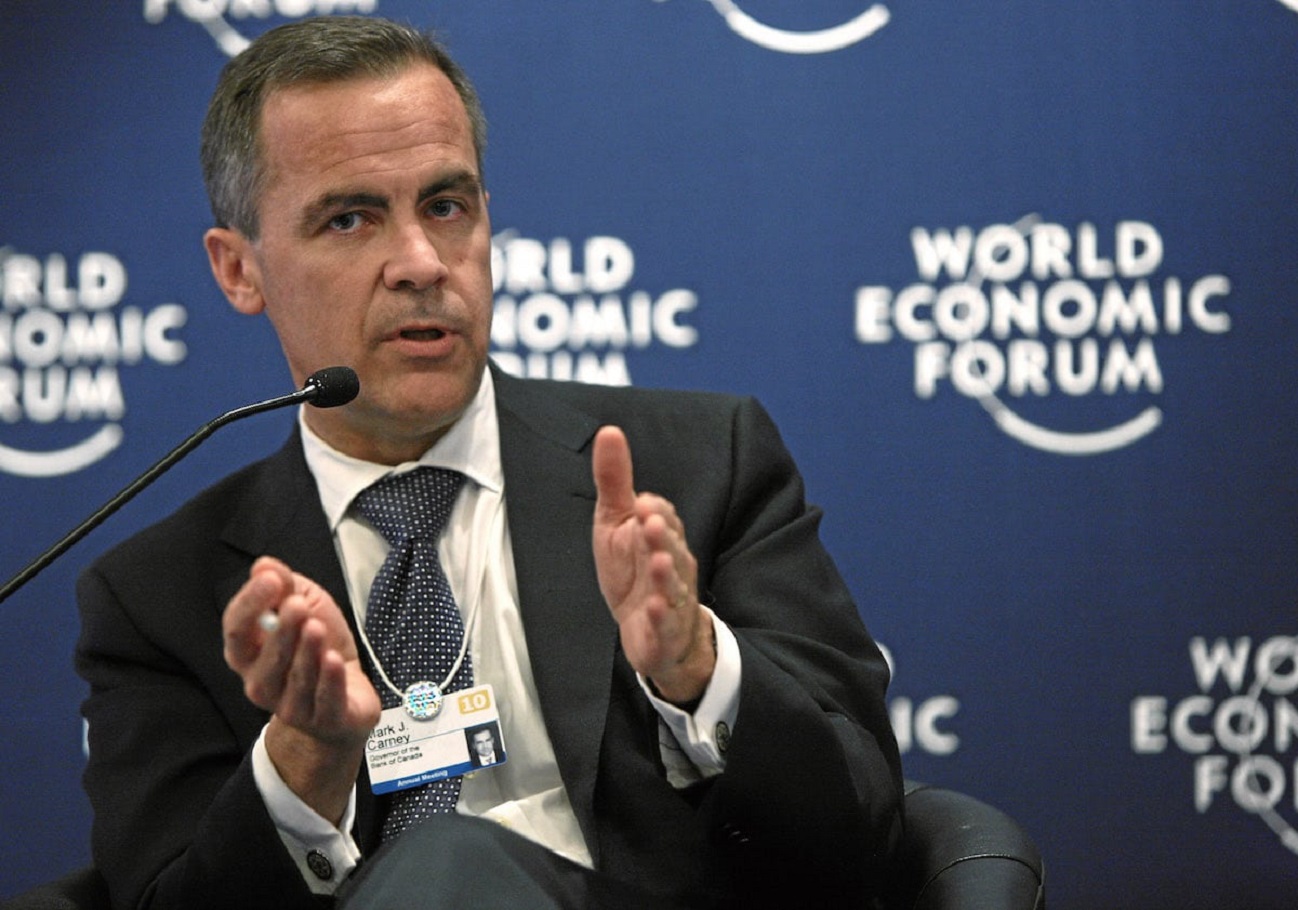
Mark Carney – formerly of Goldman Sachs & the Bank of England

One Ring To Rule Them All

Prior to his GFANZ proclamation, in November 2020, Rishi Sunak stated that the UK intended to issue the world’s first sovereign green bond. The UK Government decreed that it would make reporting to the Task Force on Climate-related Financial Disclosures (TFCD) mandatory for all UK businesses by 2025. Sunak added that this would encourage investment in new technologies “like stablecoins and Central Bank Digital Currencies”.

The UK Government added:

The UK will become the first country in the world to make Task Force on Climate-related Financial Disclosures (TCFD) aligned disclosures fully mandatory across the economy by 2025…The UK will also implement a green taxonomy — a common framework for determining which activities can be defined as environmentally sustainable.”

The UK government’s pretence that it was in control of this initiative was comical. The Stakeholder Capitalism Metrics which determine ESG asset ratings, and the development of NACs, aren’t managed by the UK, U.S. or any other elected government. These financial levers are firmly rooted in the private sector.

GPPP leaders like the Bank for International Settlements, national central banks, BlackRock, Vanguard and WEF partners like Deloitte, PwC, McKinsey and KPMG are controlling these investment strategies. Governments are just junior, facilitating partners in the Global Public-Private Partnership.

The TCFDs are evaluated in response to a company’s “sustainability report.” According to the Financial Stability Board (FSB), the sustainability report “describes a company’s or organization’s impact on society, often addressing environmental, social, and governance issues.”

The TDFD assessment determines the ESG rating of its assets. This will be the deal maker, or breaker, whenever it wants to raise capital investment.

The sustainability report standards are set by the International Financial Reporting Standards (IFRS) foundation. The IFRS foundation states that it is a non profit, public-interest organisation.

It sets agreed accountancy standards in 140 jurisdictions for both public and private organisations. Its jurisdictions include the U.S., the EU, the UK, Canada, Australia, New Zealand, China and Russia.

However its claim to operate in the “public interest” is not supported by its own statements. The IFRS foundation also reports:

IFRS Standards are set by the International Accounting Standards Board and are used primarily by publicly accountable companies—those listed on a stock exchange and by financial institutions, such as banks.”

The International Accountancy Standards Board (IASB) is a private-sector organisation. Currently 12 people supposedly decide upon the IFRS standards which stipulate the sustainability report requirements for businesses and other organisations, including governments, across the planet.

Under the chairmanship of Mark Carney – he’s a busy man – the Financial Stability Board (FSB) created the TCFD in 2015:

The Financial Stability Board (FSB) announced today it is establishing an industry-led disclosure task force on climate-related financial risks.. The Task Force on Climate-related Financial Disclosures (TCFD) will develop voluntary, consistent climate-related financial risk disclosures for use by companies in providing information to lenders, insurers, investors and other stakeholders.

Five years later it was again Carney who, knowing that the “center cannot hold,” announced the consolidation and unification of the whole system at the COP26 summit. Inline with GFANZ, the IFRS announced the next step in the process, with the creation of its International Sustainability Standards Board (ISSB.)

The head auditor at PwC, Hemione Hudson, said:

The launch today of the International Sustainability Standards Board is an important step towards achieving a global common approach to ESG related disclosure standards. Harnessing the power of the financial markets to play a leading role in the transition to a net zero economy…Reporting standards are a critical component to achieving this”

We can now see how the whole system will work.

Every business, every project they wish to embark upon, every initiative they plan and every policy they pursue must adhere to SDGs. Their compliance to the agreed agenda will be measured via their “sustainability report.”

The Task Force on Climate-related Financial Disclosures (TCFD) will judge their performance. Their ESG subcommittees, such as the International Sustainability Standards Board, will approve the relevant ESG rating for that business.

The private investment ratings agencies like Deloitte who are “members” of the IFRS and, by definition, the GPPP, will effectively control every business’s investment strategy and thus their operations. Deep-sea mining, cybersecurity, digital currency innovation, exploitation of the global commons and anything else ordained as “sustainable” will receive the corresponding ESG rating.

All of this is centrally controlled through the TCFD system, operated by the FSB. They will be able to select who prospers and who doesn’t. The FSB secretariat is “hosted” and funded by the Bank for International Settlements (BIS) and is based at BIS headquarters in Basel, Switzerland.

Not only are the central banks, under the authority of the BIS, going direct and funding global fiscal policy, they are intent upon controlling all business, all commerce and all finances. They are seizing the global commons, financializing nature and moving beyond the old IMFS to establish true global governance.

If we don’t act. If we simply allow the puppets in our so-called governments to maintain their GPPP positions then the BIS, the central banks and other “valued stakeholders” are going to seize everything on this Earth. We will be beholding to them for the resources that “all life relies upon.”

If we allow that to happen then, just like the forgotten souls abandoned to the brutality of the cobalt mines, we will all be slaves.

You can read more of Iain’s work at his blog In This Together or on UK Column or follow him on Twitter. His new book Pseudopandemic, is now available, in both in kindle and paperback, from Amazon and other sellers. Or you can claim a free copy by subscribing to his newsletter.
 
Source: OffGuardian

Monday, November 8, 2021

"Doomed to Succeed, or Downsizing Subjectivity" by John Steppling


Doomed to Succeed, or Downsizing Subjectivity

Arthur Luiz Piza

“The problem with simulations is that they are doomed to succeed.’ So runs a common criticism of simulations—that they can be used to ‘prove’ anything and are thus of little or no scientific value.”
Patrick Grim, et al (Why Simulations Fail)

“He reminds us that information means something deeper now: “It connotes a cosmic principle of organization and order, and it provides an exact measure of that.” The gene has its cultural analog, too: the meme. In cultural evolution, a meme is a replicator and propagator—an idea, a fashion, a chain letter, or a conspiracy theory. On a bad day, a meme is a virus.”
James Gleick (The Information)

“Philosophy is a battle against the bewitchment [Verhexung] of our intelligence by means of language.”
Ludwig Wittgenstein (Philosophical Investigations)

We have, as a culture, forgotten so much. How to remember, or rediscover, what we have forgotten is an essential task. It is a spiritual task more than it is anything else.

I have written before, and its been discussed on the Aesthetic Resistance podcasts, that the vastness and enormity of the Earth is the first order of forgotten.

There are a million and a half species of beetles. Over five million insect species, and that’s apparently a low ball figure since new ones are discovered each year. There are seven million species of terrestrial arthropods. There are over a billion insects for each person on earth. Insects have been around for over 350 million years. There is even an insect native to Antartica, the wingless midge (Belgica antarctica). There are upwards of twenty thousand bird species, though a recent study found six hundred new ones. Birds are apparently relatively secretive.

There are six thousand species of mammals (not counting the 96 recently extinct). One fifth of the rest are listed as endangered. The US alone has four hundred species of mammals. Nobody quite knows the numbers for reptiles since a hundred or so are discovered each year, but its about ten thousand. The most recent discovery was the Brookesia nana chameleon (from northern Madagascar), also the smallest known lizard, about the size of large sunflower seed. Twenty five thousand fish species, though again, it’s a guess. New fish, especially deep water varieties, are found almost monthly.

Lukas Felzmann, photography.


There are 390 thousand vascular plants, over 90% of which flower. And 96% of which produce seeds. There are three trillion trees in the world. Tree cover has been reduced substantially, but the number of trees has actually increased globally.

I could go on (and on and on and on). There are sixty thousand varieties of snail for example. And most can be eaten (with garlic and butter) { there are eleven varieties of garlic}. The point is that the vastness of Earth is incomprehensible. There is a cottage industry of sorts built around the notion of how vast the Universe, how incomprehensible the idea of infinity. How small our tiny planet is in comparison. But rarely, it seems, is the Earth spoken of in terms of vastness. In fact for forty years or so it has been described as small, a village, and only a tiny insignificant rock, the third from the Sun. The Green movement(s), interestingly, are oddly inarticulate about the world they claim to want to save. And that idea itself is open to investigation.

The first definition for save in the dictionary is ‘keep safe or rescue (someone or something) from harm or danger.’ The second is ‘keep and store up (something, especially money) for future use.’

The environmental movement means to save Nature, or Earth, from harm. To rescue it from danger. And therein lies a kind of an issue. And that is that one cannot quite find an adequate definition for Nature. To go to the dictionary again…’the phenomena of the physical world collectively, including plants, animals, the landscape, and other features and products of the earth, as opposed to humans or human creations.’

As opposed to humans. So humans are not part of Nature as the definition has come down to us. But putting that aside for a moment, there is a implication in most climate discussions (for example) that appeals to the authority of science. It also, by extension, implies the rescue will be technological, and this includes, usually, artificial intelligence (AI). That last relation is tenuous, I admit, but most of those eco-alarmists are relying on computer modelling. The AI adherents are everywhere, on both sides of most arguments.

Sandra Cinto

I wrote before on AI, and wont go over it all again. https://john-steppling.com/2020/11/the-mechanical-soul/

James Gleick, in a piece about Google, quotes Larry Page “Eventually you’ll have the implant, where if you think about a fact, it will just tell you the answer.” This is the exact spot at which the problem begins. Because, no, this implant will not be able to read your mind. There is no mind, per se, to read. Consciousness is not this thing. Thinking is not an internal scroll that unwinds. And a thought, a desire (I want a coke..Im thirsty) is not on this scroll, the one that doesn’t exist. Now people are deeply attracted to this idea, though. The idea that the brain, that thinking, is pretty much what a computer does. That we just have a different sort of software in there. They want this idea of brain=machine to be true (or many do).

Google expanded remarkably in a short period of time.

“How thoroughly and how radically Google has already transformed the information economy has not been well understood. The merchandise of the information economy is not information; it is attention. These commodities have an inverse relationship. When information is cheap, attention becomes expensive. Attention is what we, the users, give to Google, and our attention is what Google sells—concentrated, focused, and crystallized.”
James Gleick (How Google Dominates Us)

We are not its customers, but its product. Google makes 96% percent of its tens of billions of dollars profit from advertising. It sells our search histories, our clicks, and it puts keywords, for example, up for auction, essentially. Now, there is a mythology at work that suggests Google knows everything about you. But of course it doesn’t. I once searched for best 9mm automatic because I was writing a crime script. I just wanted some jargon, too. For months I got ads from Gun Shops, and articles from Guns and Ammo, etc. I have no interest at all in guns. This is an obvious example, but the problem, and one that I suspect is growing, is that Google users (everyone almost) start to search for what Google gives them. It’s almost a Stockholm Syndrome. People think what will please my algorithm? It may not exist in quite that way, but thinking is intentionally narrowing itself, the better to conform to the logic of internet platforms.

Edson Chagas, photography.


“It’s for your own good—that is Google’s cherished belief. If we want the best possible search results, and if we want advertisements suited to our needs and desires, we must let them into our souls.”
James Gleick (Ibid)

Now, putting aside Google’s virtues, or lack thereof, the rise of digital information processing is actually the subject here. And this is the heart of, I think, the quality of humanity’s forgetting. It is the final act for Enlightenment science, really. And it feels, to me anyway, like science itself is now self cancelling, it has reached a point of diminishing returns. Progress, as an idea (more on that below) is finding itself in curious logical cul de sacs. Of course, cutting across all this is the political projects of the new billionaire class, the most powerful men in the world, largely (save for President Xi of China and probably Putin, and maybe one or two others). The Great Reset and the new Climate emergency.

“Bridging the physics of the twentieth and twenty-first centuries, John Archibald Wheeler, the last surviving collaborator of both Einstein and Bohr, put this manifesto in oracular monosyllables: “It from Bit.” Information gives rise to “every it—every particle, every field of force, even the spacetime continuum itself.” This is another way of fathoming the paradox of the observer: that the outcome of an experiment is affected, or even determined, when it is observed. Not only is the observer observing, she is asking questions and making statements that must ultimately be expressed in discrete bits. “What we call reality,” Wheeler wrote coyly, “arises in the last analysis from the posing of yes-no questions.” He added: “All things physical are information-theoretic in origin, and this is a participatory universe.” The whole universe is thus seen as a computer…”
James Gleick (The Information)

Unknown artist, wall painting, Villa of P. Fannius Synistor at Boscoreale
ca. 50–40 B.C.

Calling the alphabet the first information technology is a bit disingenuous. But such cute concepts are attractive to the new science. Gleick then writes…“In the long run, history is the story of information becoming aware of itself.” Well, no. Although all such generalisations are bogus in the end. I wrote before about the reductive nature of AI theorists. And of the theory itself. But Gleick is very good and concise here:

“Paleolithic people began at least 30,000 years ago to scratch and paint shapes that recalled to the eye images of horses, fishes, and hunters.These signs in clay and on cave walls served purposes of art or magic,and historians are loath to call them writing, but they began the recording of mental states in external media. In another way, knots in cords and notches in sticks served as aids to memory. These could be carried as messages. Marks in pottery and masonry could signify ownership. Marks, images, pictographs, petroglyphs—as these forms grew stylized, conventional, and thus increasingly abstract, they approached what we understand as writing, but one more transition was crucial, from the representation of things to the representation of spoken language: that is, representation twice removed. There is a progression from pictographic, writing the picture; to ideographic, writing the idea; and then logographic, writing the word.”
James Gleick (Ibid)

But such schematic depictions of history are problematic in the end. And I say that mostly because there is a thumbnail representation of deep history that is highly reductive, and it is biased, unavoidably, toward the conventional notion of progress. Those cave painting were, I agree, a form of early writing. A kind of precursor to writing (see André Leroi-Gourhan), but they were also other things. As I keep noting, religion came out of theatre. And in this sense the two are almost indistinguishable. The painting and scrating on walls and rocks served several purposes, and one was, almost certainly, a depiction (and formation) of subjectivity. That interior development (which is a loaded word) was something that later systems of information (sic) began to erode. In fact the later systems, the Gutenberg Revolution, began to reshape subjectivity. It both expanded it in some ways, and contracted it in others. With the Enlightenment, the age of science, there came a new exteriority, Religion had been institutionalized and the realm of the interior was de-prioritized in favor of studying the outside world. Nature, separate from man.

At the same time, a hubris about the importance of man presided over this study of the external world. Of Nature. The assumption was that, as Alexander Pope put it, in his Essay on Man, in 1733, “…the proper study of mankind is man”.

Toko Shinoda

“As Chalmers explained: ‘I’m talking to you now, and I can see how you’re behaving; I could do a brain scan, and find out exactly what’s going on in your brain – yet it seems it could be consistent with all that evidence that you have no consciousness at all.'”
Oliver Burkeman (The Guardian, Long Read 2015)

The enormity of earth is mirrored, in one sense, by the enormity of consciousness. And at some point all AI theorists admit they have no idea what consciousness is, how it works, or anything else about it. Although, over the last decade (led by Daniel Dennett, originally, among the most unreadable of philosophers) the current position is that there is no such thing as consciousness. Its an illusion. And a waste of time to speculate about. Which sort of marks out the final dead end or blind alley of modern science and AI.

To go back a moment, when I say religion came out of theatre, I am giving theatre a very wide definition. When those cave dwellers moved about in the dark, sharing food, talking, some kind of repetitive behaviour began to take place. Rituals if you like. Whatever they were, such sharing…a men with a elk leg, warmed at the fire, walked across this space. He stopped, eyes of all the others now on him alone. He was on stage. He then held up the elk leg. He may have danced. These things took place millions of time across the planet. But what that man did was define the contours of consciousness as he felt them. If there was some ray of light from outside, he stood in it. He sensed from his dreams that this was ‘something’. Whatever sounds he made were repeated eventually, by himself and others. I think language came out of dreaming, more than it came out of play. But I suspect both were aspects were involved.

“Observation of children shows that learning to speak is for them in itself play and then serves to enrich their life of play. And the analysis of language, not a particular language but language generally, reveals its essentially playful structure. In the words of Cassirer, ‘Language is, by its very nature and essence, metaphorical’; and every metaphor is a play upon words.8 Jespersen also concludes that ‘language originated as play’.”
Norman O. Brown (Life Against Death)

Ferdinand Hodler (detail, The Night) 1890.

The infant makes sounds, imitates the mother, and this is primary mimesis. But in the world before alphabets, before texts, before history therefore, man dreamed. The infant made sounds, gazed at the face of the mother. Mimesis, before text. As he or she grew, those sounds appeared in dreams. In the cave, those dreams became performance, and, the start of language.

“No people understands any more the sensual language, and the birds in the air and the beasts in the forest do understand it according to their species. Therefore man may reflect what he has been robbed of, and what he is to recover in the second birth. For in the sensual language all spirits speak with each other, they need no other language, for it is the language of nature.”
Jacob Bohme (Mysterium Magnum,1623)

We then return to what is called ‘the hard problem’: consciousness. And one of the keys for AI: ‘information’. Now what is interesting to me, since I suffer from a kind of childhood belief in panpsychism, is that at its root, the debate around consciousness is starting to consider panpsychism, or some rarified version of it, in discussing artificial intelligence, and the ‘hard problem’.

Isamu Noguchi


Information, goes the prevailing view, is dependent on an observer. Consciousness is ontologically independent. Or, rather it is observer independent, It is subjective. For David Chalmers and Christof Koch, and a couple others, information (integrated information, i.e. that which makes a difference to a system) is, from its intrinsic position, independent of an observer. Whether one buys that or not, one can extrapolate it to suggest that machines might one day think (or have souls). The problem is, as John Searle noted (in a letter to the NYRBs answering Koch)

“One of my criticisms of Koch’s book Consciousness is that we cannot use information theory to explain consciousness because the information in question is only information relative to a consciousness. Either the information is carried by a conscious experience of some agent (my thought that Obama is president, for example) or in a nonconscious system the information is observer-relative—a conscious agent attributes information to some nonconscious system (as I attribute information to my computer, for example).”

And here we arrive at the issues around panpsychism. Koch and his co-author Giulio Tononi, wrote (in this exchange with Searle)…

“Strictly speaking, then, the IIT [Integrated Information Theory] implies that even a binary photodiode is not completely unconscious, but rather enjoys exactly 1 bit of consciousness. Moreover, the photodiode’s consciousness has a certain quality to it….”
(NYRB, 2013 March)

Tetsuya Ishida

The argument that Koch and Tononi put forward was that at its most basic level, where quarks and protons exist in some integrated relationship, there is by their definition, a tiny ‘bit’ of consciousness. This is panpsychism. And the problem for AI, with panpsychism, is summarized neatly by Wittgenstein’s often quoted

“If a lion could speak we could not understand him.”

And this relates to simulations and computer models. If everything has a form of consciousness, is in some unique way sentient, the problem is that those registers or domains of sentience are different from humans. The human cannot communicate, or even observe, the sentience of gravel or asteroids, or park benches. And I think its likely misleading to call this one ‘bit’ of information ‘consciousness’. It is something, perhaps, but like the talking Lion, I cannot know what it is. The problem of earth’s complexity resulted in early computer simulations with toy planes and flying objects failing as they were scaled up. Each step magnified complexity, though this issue has remained rather ignored.

“But the deepest objection is that the theory is unmotivated. Suppose they could give a definition of integrated and differentiated information that was not observer-relative, that would enable us to tell, from the brute physics of a system, whether it had such information and what information exactly it had. Why should such systems thereby have qualitative, unified subjectivity? In addition to bearing information as so defined, why should there be something it feels like to be a photodiode, a photon, a neutron, a smart phone, embedded processor, personal computer, “the air we breathe, the soil we tread on,” or any of their other wonderful examples? As it stands the theory does not seem to be a serious scientific proposal.”
John Searle (Ibid)

This is an insanely complex topic and I want to try to point to some of the problems with the increasingly popular fantasies of AI (and Metaverse, and with computer modeling, and with Google and its mind reading aps, etc).

Andy Denzler


“We are thus facing the following strange situation. While all building stones for the [modern scientific] world-picture are furnished by the senses qua organs of the mind, while the world picture itself is and remains for everyone a construct of his mind and apart from it has no demonstrable existence, the mind itself remains a stranger in this picture, it has no place in it, it can nowhere be found in it. “
Erwin Schrödinger (On the Peculiarity of the Scientific World-View)

And the following paragraph is very much to the point…from Edward Feser:

“In the case at hand, neuroscientists who begin, as every empirical scientist must, with observations – that is to say, with conscious experiences whose character is determined by various sorts of qualia or sensory qualities – go on to construct a theoretical description of the physical and neural processes associated with perception. This theoretical description then takes on, as it were, a life of its own, coming to seem as real or even more real than the concrete experiences that led to it, and the language in which the former is couched comes to be applied to the theorist’s description of the latter. Thus an explanation of “heat” in the sense of molecular motion comes to seem, especially when coupled with neuroscientific data, an explanation of “heat” in the sense of a certain kind of tactile sensory quality; an explanation of “red” in the sense of light of a certain wavelength comes to seem an explanation of “red” in the sense of a certain kind of visual sensory quality; and so forth.”
Edward Feser (Schrödinger, Democritus, and the paradox of materialism)

Scientists today are ever more specialized, and as Feser notes later in that article, ever less philosophically educated. The idea that mapping neural signals in the brain, even in the most detailed and exhaustive manner, is in anyway at all an explanation of mind, is really pretty obvious, but alas, today it is not. It is, I think, an expression of the dominance of purely mechanistic explanations of everything.

Of course there are other issues entering this discussion. Political ones, for openers. As my friend Johan Eddebo noted in conversation, this digital accumulation of facts is really capitalist property relations come full circle. And I wrote last posting about the much underrated influence of Taylorism to not just our material world, but to our psychology.

Carlo Borer

“In fact it is scientism which fosters obscurantism, ignoring as it does clear conceptual distinctions and forcing all intellectual life into a methodological procrustean bed. And in fact the mechanistic “objectified” conception of matter inherited from the early moderns is not a scientific discovery at all but a philosophical posit, and one which creates philosophical problems rather than solves them.”
Edward Feser (Ibid)

and one more from Feser:

“Rather, what is necessary is just the ability to see that it is only persons, rather than any of their components, who can intelligibly be said to be conscious, to think, to perceive, to act, freely to choose, and so on (just as it is paintings and words, rather than the paint or ink splotches they are made up of, that can intelligibly be said to represent things, to have syntactic and semantic features, and so forth). Hence, from a failure to locate such activities at the neuronal level, it simply does not follow that the activities do not exist — again, one must presuppose reductionism to draw that sort of conclusion, so that a failure to locate the activities at the subpersonal level hardly establishes reductionism. Similarly, it makes no sense to attribute the activities in question to the subpersonal level (as some reductionists do) — to characterize neural processes as “deciding” this or “perceiving” that. Only persons decide, perceive, think, freely choose, etc., if anything does. Hence it is to the level of persons as a whole, and not to their parts, that we must look if we are fully to understand what is happening when we think, perceive, feel, choose, act, etc.”
Edward Feser (Reading Rosenberg, Part IV)

Luis Feito

The current project to create digital IDs, vaccine passports (sic), microchip markers for everyone, all of this is the product of a class system that Marx outlined pretty convincingly 150 years ago. But this particular moment, in 2021, represents the culmination of a phase, or project, from the ruling class (the very wealthy) which coincided with the enormous transference of wealth (of all kinds) to the very tip top 1% over the last ten to fifteen years. And this particular phase of oppressing the vast majority of mankind is being marketed and given cover by two separate but related campaigns. One is the Covid pandemic, and the other is the Climate Emergency (or global warming, etc). Capitalism had reached some kind of final crisis in 2008. I say final, but of course it wasn’t really final. Nothing is ever really final in the class struggle. But the system needed to be renovated. Refurbished somehow. And this has all been fairly well outlined by many writers, Cory Morningstar among them. Economists like Ernst Wolff have provided pretty clear explanations. So I don’t need to go over it all again. What interests me though are two things. One is why so many, maybe half, maybe less, of the global population buys into it. And two, what sort of world is being imagined by those trying to reshape it.

The second question overlaps a bit with the first. And to return to the very top of this posting, the issues surrounding science, and the belief, nearly religious, about computer technology, and all things digital, is a significant factor in how and why this is happening. The climate discussion is linked at its core with computer modelling. All the various predictions and solutions and demands you have read for twenty some years, not to mention the recent summit on climate at Glasgow, suggest both a trend toward blind trust in the authority of computer technology and analysis, and by extension, there emerges something amenable to fascism.

It is revealing to look at the early promos for Metaverse, because this is a cartoon world. The aesthetics are appallingly childish and ugly. And this is something I’ve not heard a single comment about. Aesthetic regression passes without notice, it seems.

Gyoshu Hayami


Various religious traditions in both East and West took a non mechanistic path — a path to where might be a relevant question, one actually never asked in western science.

“Śaṅkara repeatedly discusses the reasons why other means are inapplicable. He comments often on the limits of sense perception in relation to knowing brahman. Each sense organ is naturally capable of revealing a quality that is appropriate to its own nature.Sound,sensation, form,taste and scent are their respective spheres of functioning. Brahman, however, remains unknowable through any of these because of its uniqueness. Brahman is without sound, touch, form, taste, or smell and is therefore outside the domain of these sense organs. Kaṭha Upaniṣad 1.3.15 speaks of brahman as “that which is soundless, touchless, colorless, undiminishing, and also tasteless, eternal, odorless, without beginning, and without end, greater than the greatest, and ever constant.” Brahman is limitless, while to become an object of sense knowledge is to be finite and delimited, to be one object among other objects. A brahman that is appre- hended through the senses is, from the Advaita viewpoint, a contradiction. In his commentary on Bhagavadgītā 13:12, for example, Ṡaṅkara rejects the claim that there is a contradiction in the denial of brahman as both sat (existent) and asat (non-existent) by interpreting these terms to signify the non-availability of brahman as an object of sense knowledge.”
Anantanand Rambachan (That From Which All Words Return”: The Distinctive Methods of Language Utilization in Advaita Vedānta)

There is no idea of mastering Nature in Advaita Vedanta.

Elizabeth Underhill defined mysticism as “the science of self-evident Reality.” (Mysticism).

Julio Romero de Torres

Sikh mysticism is also devoted to the emergence of the truth from out of the ineffable. Much of Taoism, too. And so is much of Christianity, in fact. I am digressing a bit here, but it seems rather relevant when discussing contemporary science and AI.

“Now etymology depicts the process of language in time. And it is a commonplace of the subject that, whatever word we hit on, if we trace its meaning far enough back, we find it apparently expressive of some tangible, or at all events, perceptible object or some physical activity.”
Owen Barfield (A Study in Idolatry)

Barfield adds later…“Speech did not arise as the attempt of man to imitate, to master or to explain ‘nature’; for speech and nature came into being along with one another. Strictly speaking, only idolators can raise the question of the ‘origin of language’. For anyone else to do so is like asking for the origin of origin { } The split between sound and meaning—for their relation in any modern language is no more than vestigial—is one aspect of the ever-widening gulf between outer and inner, phenomenon and name, thing and thought…”

What is being called the 4th Industrial Revolution (accompanied by all the aforementioned projects from the WEF, the WHO, and assorted NGOs, as well as Google, Microsoft, et al) are a piece in their goals. I am not sure you can call them dreams or desires. I do not think Bill Gates or the CEOs of Google or Zuckerberg or whoever economically funds these guys, for many are simply the public face of other more hidden economic engines and players, actually experience desire. The point is that these goals are all part of the war on humanness. If that sounds exaggerated, I don’t think it is. On the podcasts we have talked of the War on Reason. And when you consider the ideas of those cheerleaders for AI, and transhumanism, there is a clear emotional regress. This age is witnessing the final self annihilation of western progress. From Hiroshima to the Gates funded lab in India where human DNA is mixed with animal DNA, in experiments that are largely secret, from slavery to coercing an experimental vaccine (not a vaccine, but a gene therapy, really) onto children, even infants if all goes according to plan, from Manifest Destiny to android sex dolls, it’s hard not to see a looming catastrophe. It is the end game for Capitalism.

Oppenheimer, left, and Jon Von Neumann, 1953. In front of first electronic computer, Princeton.


I want to end with a few assorted observations on AI, on digital tech, on cyber science in general. Data is increasingly being collected. Mountains and mountains of it, and stored at great expense and with entailing enormous pollution.

“Nowadays, we are drowning in a flood of information. Paradoxically, all sense of global understanding is in acute danger of getting washed away. Each overcoming of technological barriers opens a Pandora’s box by revealing hidden variables, mechanisms and nonlinearities, adding new levels of complexity.”
Yves Fregnac (Science, Oct 2017)

As Fregnac, a French neuroscientist, has said elsewhere, ‘data is not knowledge’. I began with the idea of earth’s vastness. Perhaps because I live in a sparsely populated region of a sparsely populated country, but I feel when I drive through the forest areas here a kind of humility, and I think, just this single lake, a small lake, and Norway has over sixty thousand lakes (Sweden has ninety thousand), and it would take me a lifetime to really know everything about it. It would years and years of observing and walking around this lake to get any real familiarity with it. Where I live, just down the hill …which I can see from my porch, is a tidal island. At low tide you can walk out to it, over slippery rocks, but you can, and I have countless times. At high tide you would have to swim. Its several feet deep in fjord waters and you need a boat to land on the back side. There is even a tiny unmanned lighthouse on this tiny island. Ive lived her for almost six years now and I remain fascinated by this island. A Norwegian eagle has a nest out there. I found the tree. Regularly we see the eagle circling. It’s a majestic sight. Mezmerizing, actually. And there are sixty thousand more islands in this country. There are near infinite numbers of inlets and canals and forests. Each is complex enough to take years of study to know firsthand. So, when I think about this I wonder at the delusions of computer modelling on a global scale. For anything. For there is a bias in models, for success. As Grim and his fellow researchers noted (at the top of the page), you can make models say anything you want. Much like statistics. Capitalism has indoctrinated people to embrace an idea of success, success at all costs. Capitalism is a world of winners and losers. Success is winning. And it is a curse.

“We are being pushed, with this anti-humanist idea that humanity is inherently evil, and we have to reject that.”
Gucharan Singh (Video interview, The Agenda of the New World Order is Depopulation)

Rubens Gerchman


There is a new Puritanism that accompanies the green movement. Its as if desire leaves too big a carbon footprint.

“But among Enlightenment luminaries such as Bernard Mandeville, David Hume, and Adam Smith, the ideals of simplicity and asceticism were being supplanted by a “rehabilitation of desire,” in Christopher Lasch’s words, in which the incessant, indefinite multiplication of material wants was lauded as the engine of progress { } While Christian sentimentalism leavened an ethic of benevolence and humanitarianism that issued in abolitionism, factory reform, and the extension of the suffrage, it also constituted a new form of enchantment that provided the English bourgeoisie with a moral license to participate in fashionable consumption. Thus, Campbell implies, modern capitalism rests on a metaphysical fault line: a profane, inanimate external world given over to calculation and control, and a hedonistic, “enchanted” internal realm of daydream, fantasy, and romance. In a world increasingly understood in terms of Newtonian physics and mechanism, what John Brewer has dubbed “the pleasures of the imagination” became new enchantments of capitalist modernity.”
Eugene McCarraher (The Enchantments of Mammon)

Where once the idea of consumerism was coded with class markers, it was overall, for probably two hundred years, an idea seen as a by product of industry and hard work. Today, the downsizing of not just businesses but subjectivity is cast as moral restraint. The consumer of Enlightenment times was also a sober scientist of the material world. Masculinity was forged in what Campbell calls a metaphysical fault line, one that leaned heavily toward the external world of materialism. Of science. Fashion was pleasure, it was eroticised certainly, but it carried enough of the old Puritanism to grant priority to the world of rational thought. Albeit an instrumental rigid form of reason.

The new environmentalist is a return to a kind of sado-masochistic anality. Science has reached, in its digital form, a uncomfortable lack of promise, notwithstanding the promises of global celebrity billionaires. Trust the Science is given lip service, but behind that is no real identification. The new green subject is part new age holdover, part lay science nerd, and part evangelical self flagellator. The theme of self flagellation is rife in entertainment (see DaVinci Code, Silence of the Lambs, et al). Much as zombies hold appeal, the reconstruction narratives they entail, the self flagellator is pure fascist style. Its mildly homoerotic, and just transgressive enough to be openly (sort of) embraced.

Raghubir Singh, photographer.


The self flagellator is also the legatee of Pogo , ‘the enemy is us’. It is the metaphoric expression of humanity-as-blight. The kitsch and sentimental confessional, a trope that peaked in the 70s and 80s (in terms of Hollywood TV) has moved on to the political (and religious …see Jim and Tammy Fe, and various other Televangelists) and social. In fact, social media, for all its bullying and stigmatizing is actually close to a soap opera in terms of content sophistication. The fascist is always driven to dominate (in narrative terms, and style codes) but he or she is also self punishing. Masochistic. The confessional has merged with self flagellation, joined in union by the ubiquity of the sentimental. Confession has always been partly narcissistic, but today it is the narcissism of the dominatrix/dom or master. Entertainment themes favor the suffering of power, not of the victim. The huge victims rights movement only slightly camouflages this fact.

London cabbies (the black cab trade) must learn what is called ‘the knowledge’) It takes several years of study, truly difficult study, to become a London cab driver. Its a beautiful thing, the knowledge. https://www.nytimes.com/2014/11/10/t-magazine/london-taxi-test-knowledge.html

Now, does GPS replace that knowledge? It that an improvement? Well, no, clearly not. But economics plays into this, too. Cabs are expensive in London. The working class ride the underground and walk. Still, I’m not at all sure anything can replace that kind of learning. And partly, as the author of the Times pieces notes, its about civic history.

“The Knowledge says that London is Holy Writ, a great mystery to be pored over, and that a corps of municipal Talmudists must be delegated to that task. To the extent that the mystifying clichés hold — that taxi drivers are London’s singers of songlines and fonts of folk wisdom, carrying not just the secrets of London navigation but the deep history of the city and its streets — the disappearance of the Knowledge would be an assault on civic memory, a blow, if you will, to historic preservation.”
Jody Rosen (NY Times Nov 2014)

Perhaps that idea of history is part of what seems problematic in data collection as an end in itself. Its not knowledge. And pure accumulation is pointless or even damaging.

“I have a general feeling of unease when contemplating complex systems dynamics. Its devotees are practicing fact-free science. A fact for them is, at best, the output of a computer simulation: it is rarely a fact about the world.”
John Maynard Smith (Life on the Edge of Chaos, NYRB 1995)

Kirsten Lilford

Culture continues to move further and further from the real world, and in the process the real world is being forgotten.


Source: John Steppling

COVID-19 and the 8th Day Protocol: It Deserves Urgent Global Attention


COVID-19 and the 8th Day Protocol: It Deserves Urgent Global Attention

Dr. Shankara Chetty and Omar Khan in dialogue about Dr. Chetty’s breakthrough Protocol and “the two Sciences”...models vs real world data.

Go to source to watch video: Omar Khan

Or go to Rumble to watch video and read accompanying article, which is below: 


Rumble — Dr Shankara Chetty’s “8th Day Protocol” deserves urgent global attention. He achieved 100% success with over 7,000 patients, no oxygen needs developed, none needed hospitalisation and none died.

Dr Chetty operates from an open-air clinic in rural South Africa, and no infection spread among his staff. His Protocol has been successful with the first wave, second wave, Delta wave, and with those getting reinfected post vaccination. The Protocol is being studied and applied in India, Indonesia, Malaysia, US and other countries.

Dr. Chetty is a general practitioner with a natural science background in genetics, advanced biology, microbiology and biochemistry.

Omar Khan has distilled and helped convey “the 8th Day Protocol” and how it represents a fundamentally new paradigm of COVID treatment, without requiring any “controversial” or off label drugs. In Sri Lanka front-line doctors have been successfully applying its principles.

Along with Dr. Chetty, Omar also has been focused on the “two sciences” that seem on display…the orthodoxy and the science shared by the sceptics. The first is based on modeling, and front-line clinicians like Dr. Chetty who focus on actual patient data. Omar shows how most of the “debates” evaporate when people are explicit about which paradigm they are applying.

Omar Khan is a global consultant who has advised clients in the US, UK, Europe, South America, South Africa, the Middle East, Southeast Asia, Asia Pacific and Australia on leadership responses to opportunities and crisis. His firm, EPL Global seeks to convey better information for better decision making.

Asia Pacific Today. October 30, 2021

Asia Pacific Today believes that your opinion is legitimate. And we believe that our guests have something to say and that their opinion is also legitimate. Throughout the week, Mike Ryan has discussions about politics, polarising issues, current events, and more. We really are connecting with people all over the world that simply speak their mind. There's new videos throughout the week, every week on our website.

And we also need our audience to grow. It would really help us grow if you could subscribe to https://www.asiapacifictoday.tv

Shankara Chetty, Dr Shankara Chetty, Dr Shankara Chetty’s 8th Day Protocol, 8th Day Protocol, Omar Khan, Omar Khan 8th Day Protocol, leaky VACCINES, Vaccine dangers, lockdowns, covid, covid-19, covid vaccines, vaccine deaths, vaccine injuries, vaccinations, vaccinations Australia

Source: Rumble

"Biden and Congress Agree: Build Back Bombs Better" by John V Walsh


Biden and Congress Agree: Build Back Bombs Better

$1.75 Trillion for the Social Welfare/Climate Bill; $1.75 trillion for “modernizing” nukes

Last Friday Congress passed the Biden “Infrastructure” Bill which will be signed into law post haste says the White House. The bill, designed to upgrade roads, bridges, transport and broadband, is a bricks and mortar affair and will benefit industry and commerce. It is the first of two bills that have been the center of attention for months now.

The second bill is the Build Back Better Bill. This bill has provisions for child care and preschool, eldercare, healthcare, prescription drug pricing, immigration and curbing greenhouse gas emissions. This might be described as a bill for people not for bricks and mortar. It has been the darling of progressives in Congress. The White House has now promised it will come up for a vote by November 15.

Whatever one may think of the “Build Back Better” Bill, there is no doubt it is a shadow of its original self. The total for Build Back Better was to be in the neighborhood of $6 trillion, as originally envisioned by Congressional progressives, and then it slipped to about $3 trillion and now it has shrunk again to $1.75 trillion — the incredible shrinking Build Back Better Bill. It is woefully inadequate. On health care, greenhouse gases, family leave, education and other matters, it is little more than a stingy beginning.

Now look at the cost of “upgrading” and “modernizing” the US nuclear arsenal, a program which was originated by Barack Obama, after he got his Nobel Peace Prize, and has now ballooned beyond its original abdominous $1 trillion price tag to a stunning $1.75 trillion. No shrinkage there. For both Parties no cost is too high to keep us poised every instant on the razor edge of Accidental Armageddon.

Nuclear weapon “modernization,” however, is only one small corner of the total picture. Let’s look at the entire military budget. Biden’s first budget for the Pentagon and nuclear weapons, for fiscal 2022, is about $750 billion. The spending on the Build Back Better Bill is to extend over 10 years, yielding an average expenditure of $175 billion. Biden’s “transformative,” historic” Build Back Better Bill gets only 23% percent of the Pentagon budget – assuming the latter is not fattened up even more.

The situation is even more barbaric when we look at the entire “national security” budget which includes the yearly budget of the 17 “intel” agencies and comes to $1.3 trillion. No expenditure is too great, it seems, to ensure that the Feds track all our phone conversations and emails and harass every unsuspecting Chinese student and academic they can get their mitts on. It would take only 13% of that $1.3 trillion to fund Build Back Better.

For weeks the mainstream media has been burdening its audience with a grueling daily account of the Build Back Better Bill, with tedious detail about inter- and intra-partisan quarreling. The basic tale is that Senator Manchin is standing in the way of all that is good, holy and angelic in the political world. True, but that makes him nothing more than a typical Senator. However, the Manchin morality play touches on a simple but important question for those already feeling the limber fingers on their wallets of the insidious pickpocket, inflation. How are we to pay for Build Back Better? Regardless of which side of the question you come down on, cost constitutes an obstacle in influential quarters.

From all of the above, a compelling proposal emerges. A 23% cut in the military budget (or if you wish to cast your net wider, a 13% cut in the “national security” budget) will fund the entire Build Back Better Bill – with no more cuts. With a 23% cut for fiscal 2022, the military budget drops from $750 billion to $580 billion. That is well in excess of the combined military expenditures of $314 billion for China ($252 billion) and Russia ($62 billion.) In fact a cut of 50% in the military outlay would still leave it at $375 bill, still higher than the combined expenditure of Russia and China. If an elected official cannot agree to that, they are either paranoid or a hegemonist up to no good. In either event they should be barred from public office.

The military budget of $750 billion is now under “continuing resolution,” which means interim funding until a final vote can be taken in the weeks ahead. One needs no crystal ball to forecast broad bipartisan support for this piece of legislation. The only serious discussion will be how much to increase the amount. “Bomb Back Better,” if we might call it that, will sail through Congress and White House as effortlessly as a vulture on the wing.

Common sense suggests we transfer our hard-earned dollars from guns to butter, but no such prospect is in sight. Only one act is required to get to that promised land. We must not vote for anyone who cannot see their way to an ironclad commitment to a 50% cut in the National “Security” Budget – for starters. It’s as easy as that.

John V. Walsh can be reached at john.endwar@gmail.com. He writes about issues of war, peace and empire, and about health care, for Antiwar.com, Consortium News, Dissident Voice.org and other outlets. Now living in the East Bay, he was until recently Professor of Physiology and Cellular Neuroscience at a Massachusetts Medical School. Read other articles by John V..
 

"Medicine Wants to Kill You" by James Howard Kunstler


Medicine Wants to Kill You


Historians of the future, savoring ‘possum goulash around their campfires, will marvel that modern medicine squandered its authority, its credibility, and its sacred honor in the Covid Panic of the 2020s, when public health officials and doctors in clinical practice colluded to force mass vaccinations while suppressing news of the harms and injuries the vaccines caused — potentially sacrificing millions of citizens like so many experimental fruit flies.

Poster-boy for this epic debacle was Dr. Eric J Rubin, editor of the New England Journal of Medicine who, serving on the CDC’s advisory vaccine committee, actually said, “We’re never gonna learn how safe the vaccine is until we start giving it.” Giving it to children, that is, which the government authorized last week, even while that same CDC issued a safety advisory warning on vaccine-induced myocarditis (inflammation of the heart), especially in boys and young men.

Nota bene: myocarditis is not a condition you necessarily get over because affected heart muscle cannot replace itself; rather the inflammation leads to scaring of heart muscle and a shortened life-span.

Meanwhile, young vaxxed athletes drop dead of heart failure in shocking numbers on high school gridirons, soccer fields, cricket pitches, bike trails, and running tracks around the world, and ordinary civilians develop a bewildering array of post-vax cardiovascular, neurological, and thrombotic disorders of which only a small fraction end up being recorded in the CDC’s Vaccine Adverse Events Recording System (VAERS).  Those numbers now are at least roughly 10,000 deaths and 20,000 permanently disabled. The VAERS website is so kludgy and inadequate that doctors are discouraged from using it — to the degree that only an estimated 10 percent of adverse events are actually reported. Doctors are also threatened with disciplinary punishment for publicizing problems with the vaxxes.

In fact, the news can’t be completely suppressed. It is obvious now — due to the frantic push for “booster” shots — that the various vaccines stop working to prevent infection with Covid-19 after several months. What is only partially understood is the action of the spike proteins that linger in the body post-vax, but the evidence is not good, since they have a particular affinity for attaching to the endothelial linings of blood vessels generally, and in the capillaries of major organs in particular — especially ovaries and testicles, raising the specter of widespread infertility ahead.

On top of that, the vaccines are suspected of breaking down the immune system, leaving the vaxxed vulnerable to opportunistic infection, disabling the genetic mechanism that allows the body to routinely defeat cancer cells, and turning people’s immune systems against them in auto-immune disorders.

How are the doctors and public health officials behaving in the face of all this? Pushing ever more strenuously for the forced vaccination of everybody of all ages, no matter what, and vilifying anyone who militates for respecting informed consent to be vaccinated. The net result is that doctors appear to have violated en masse their Hippocratic oath of ethics which calls on them to first do no harm.

Everything about the virus and its countermeasures — from the murky origins of it in Dr. Anthony Fauci’s official funding of bioweapons research, to the patent trail of conflicted ownerships and interests in the subsequent vaccine developments, to the fierce suppression of news and debate — suggests nefarious motives, or else a mass psychotic panic among the very highly-trained people society must depend on in a crisis.

It’s also getting harder to tell how much of a crisis this actually is or ever really was. There’s no reliable way of knowing how many people really died as a direct result of Covid, or just tested positive for the virus (with a janky PCR test) when they were struggling with one or more serious illnesses (co-morbidities), especially when there were substantial dollar subsidies at stake from the federal government tied to Covid cases. Nor is it possible to determine right now how many deaths attributed to Covid are actually a result of reactions to the vaccines. Most troubling of all, it looks like the rate of deaths from cardiac disorders, thrombosis, and neurological damage in the general population is noticeably exceeding the normal range — as reported officially in the UK, Ireland, and other countries.

It bears repeating that whatever Covid-19 actually is or where it came from, it’s a disease not a whole lot more deadly in the general population than the flu in a bad season; that in the natural course of things, it would have probably only killed mostly the very old and already sick, and that the rest of the population would have soldiered through it and acquired a sturdy natural immunity superior to anything the vaxxes might confer (even in theory).

My own doctor tried to persuade me to get vaxed-up during a routine physical in October. I asked him if he was aware of the thousands of deaths and disabling adverse events reported on the CDC’s VAERS system. He said the numbers were not true and went on to say that he had “one hundred percent confidence in the vaccines.” He’s always appeared to be a smart and capable person. A year or so ago he was enlisted to act as an executive administrator in the health care org he practices in, and now only sees patients two days a week. Perhaps that leaves him no time to follow the news. Or maybe he has no inclination to follow any news except what comes from sources like cable TV channels, which are almost entirely sponsored by the Pharma industry.

The bottom line for me is that he has compromised my faith in his judgment. I wonder how many other people feel that way about their doctors. The medical profession was already in trouble before Covid came on the scene. It had entered into a demonic symbiotic relationship with the insurance industry that amounted to pervasive racketeering. (Just imagine the hospital bills of all those people with adverse vax reactions that the doctors affected to be mystified by, and ran countless, fruitless tests on.)

The good news for now is that a federal court has stayed the “Joe Biden” vax mandates. The government is expected to dispute that decision today (Monday Nov 8). Meanwhile, the rumor of a general strike against vaccine tyranny, set for today through Thursday, is in the air and we’ll have to stand by to see if anything happens. We should also be standing by in the weeks ahead to see how many more people begin to show symptoms of developing serious bodily disorders from the multiple shots they have been suffered to take.


Source: Clusterfuck Nation

Sunday, November 7, 2021

" Pfizer 'vaccine': kill 200 to ‘save’ one? Analysis of official data shows the risks attached to Covid 'vaccine' far outweighs any theoretical reward." by Kit Knightly


Pfizer “vaccine”: kill 200 to ‘save’ one? Analysis of official data shows the risks attached to Covid “vaccine” far outweighs any theoretical reward.

Kit Knightly
 

In the early days of the “vaccine” rollout, we ran several articles discussing the risk-reward of the new mRNA jabs. Dr Sadaf Gilani, in particular, did good detailed write-ups on “absolute risk reduction”.

To explain “absolute risk reduction” (ARR) in simple terms: if an unvaccinated person has 10% of getting the disease, and a vaccinated person has a 1% chance, then the ARR for the vaccine is 9%.

Of course, that’s just an example, the actual ARR for the Covid “vaccines” is nowhere near 9%:

This is the absolute risk reduction for Pfizer/BioNtech (each group had over 18,000 people):

Injection Group: 8/18,198 = 0.04%
Placebo Group: 162/18,325 = 0.88%

Absolute risk reduction = 0.84%

From the “absolute risk reduction”, you can then calculate the “number needed to vaccinate” (NNTV). This is the rough number of people you need to inject in order to definitely prevent one case/death.

To continue the example above, if your vaccine reduces the odds of infection from 10% to 1% (an ARR of 9%), you need to vaccinate eleven people to prevent one infection, giving you an NNTV of 11.

Again, the NNTV of the Covid vaccines are much, much, MUCH higher than 11. Estimates range from between 88 and 700 to prevent a single case, and anything up to 100,000 to prevent one solitary death.

And remember, all this data was for adults. Children are at a far lower risk from Covid – both in terms of hospitalisation and death. In the US, children aged 5-11 have a 99.992% chance of surviving “Covid” – so it naturally follows the NNTV for this group will be far, far higher than for adults.

But, now that the FDA has approved Pfizer’s “vaccine” for emergency use on children aged 5-11, “far, far higher” is not good enough. We need to calculate an actual figure for the “number needed to vaccinate” in order to hypothetically protect one child from dying “with Covid”.

Fortunately for us, someone else has already done it.

Writing on his Substack, economist Toby Rodgers PhD has collated the numbers from Pfizer’s own trials, the FDA and the CDC and done a very thorough write up. You can read the whole thing here, we’ll just present you with some of the highlights:

As of October 30, 2021, the CDC stated that 170 children ages 5 to 11 have died of COVID-19-related illness since the start of the pandemic. (That represents less than 0.1% of all coronavirus-related deaths nationwide even though children that age make up 8.7% of the U.S. population).

The Pfizer mRNA shot only “works” for about 6 months (it increases risk in the first month, provides moderate protection in months 2 through 4 and then effectiveness begins to wane, which is why all of the FDA modeling only used a 6 month time-frame). So any modeling would have to be based on vaccine effectiveness in connection with the 57 (170/3) children who might otherwise have died of COVID-related illness during a 6-month period.

At best, the Pfizer mRNA shot might be 80% effective against hospitalizations and death. That number comes directly from the FDA modeling (p. 32). I am bending over backwards to give Pfizer the benefit of considerable doubt because again, the Pfizer clinical trial showed NO reduction in hospitalizations or death in this age group.

So injecting all 28,384,878 children ages 5 to 11 with two doses of Pfizer (which is what the Biden administration wants to do) would save, at most, 45 lives (0.8 effectiveness x 57 fatalities that otherwise would have occurred during that time period = 45).

So then the NNTV to prevent a single fatality in this age group is 630,775 (28,384,878 / 45). But it’s a two dose regimen so if one wants to calculate the NNTV per injection the number doubles to 1,261,550. It’s literally the worst NNTV in the history of vaccination.

630,000 children injected with 1.2 million doses to save one life. That’s incredibly inefficient. However, it could be even worse than that.

As we covered last week, according to statistics cited at the VRBPAC meeting, only 94 children from the 5-11 age group have died. If this lower figure is correct, the NNTV to prevent a single death jumps up to 915,641.

In other words, in order to hypothetically prevent a single child from dying over a six month period, you would have to inject nearly one million children with almost two million doses of the Pfizer vaccine.

What kind of risk are those 915,641 children facing from their two doses of Pfizer mRNA soup?

Well, early studies found around 11.1 cases of severe anaphylaxis per million doses of the Pfizer shot, so already any “fully vaccinated” child is almost 22x more likely to have an allergic reaction than to actually be protected from Covid.

Other severe reactions are harder to calculate.

It is known, for example, that Pfizer’s own trial showed increased all-cause mortality in the vaccinated group vs the placebo group, to the point the trial was abandoned after six months and all remaining placebo members were given the vaccine, effectively destroying the control group. To quote Rodgers again:

As Bobby Kennedy explains, Pfizer’s clinical trial in adults showed alarming increases in all cause mortality in the vaccinated:

“In Pfizer’s 6 month clinical trial in adults — there was 1 covid death out of 22,000 in the vaccine (“treatment”) group and 2 Covid deaths out of 22,000 in the placebo group (see Table s4). So NNTV = 22,000. The catch is there were 5 heart attack deaths in the vaccine group and only 1 in placebo group. So for every 1 life saved from Covid, the Pfizer vaccine kills 4 from heart attacks. All cause mortality in the 6 month study was 20 in vaccine group and 14 in placebo group.

So a 42% all cause mortality increase among the vaccinated. The vaccine loses practically all efficacy after 6 months so they had to curtail the study. They unblinded and offered the vaccine to the placebo group. At that point the rising harm line had long ago intersected the sinking efficacy line.

Former NY Times investigative reporter Alex Berenson also wrote about the bad outcomes for the vaccinated in the Pfizer clinical trial in adults (here). Berenson received a lifetime ban from Twitter for posting Pfizer’s own clinical trial data.

It’s not in Big Pharma’s interest to have an accurate collation of severe vaccine reactions, combine this with the (acknowledged) potential for totally unknown long-term side effects, and calculating the complete potential risk becomes very complicated.

However, Rodgers – using the VAERS data as his basis – makes a very reasonable effort:

  • Because the Pfizer clinical trial has no useable data, I have to immuno-bridge from the nearest age group.
  • 31,761,099 people (so just about 10% more people than in the 5 to 11 age bracket) ages 12 to 24 have gotten at least one coronavirus shot.
  • The COVID-19 vaccine program has only existed for 10 months and younger people have only had access more recently (children 12 to 15 have had access for five months; since May 10) — so we’re looking at roughly the same observational time period as modeled above.
  • During that time, there are 128 reports of fatal side effects following coronavirus mRNA injections in people 12 to 24. (That’s through October 22, 2021. There is a reporting lag though so the actual number of reports that have been filed is surely higher).

At this point, going purely off official data and VAERS reports, you can conclude that injecting every 5-11 year old in the US would theoretically save approximately 31 lives, but kill roughly 116 children.

That’s clearly already a very bad outcome. However, if the predictions for under-reporting of vaccine harms are accurate, it’s potentially much worse than that:

  • Kirsch, Rose, and Crawford (2021) estimate that VAERS undercounts fatal reactions by a factor of 41 which would put the total fatal side effects in this age-range at 5,248. (Kirsch et al. represents a conservative estimate because others have put the underreporting factor at 100.)
  • With potentially deadly side effects including myo- and pericarditis disproportionately impacting youth it is reasonable to think that over time the rate of fatal side effects from mRNA shots in children ages 5 to 11 might be similar to those in ages 12 to 24.

[…]Imagine that, at most half of American parents will be foolish enough to inject this toxic product into their kids. At a 50% uptake rate, the ACIP decision to approve the Pfizer shot will likely kill 2,624 children via adverse reactions in order to potentially save 12 from COVID-19-related illness.

In conclusion, going purely off official data, vaccinating 5-11 year olds will create 22 allergic reactions per death prevented, and could very well result in four deaths per life saved.

And, if Rodgers’ calculations are correct, the Pfizer shot could kill over 200 children before it has saved a single one.

As always, the point of this analysis is to illustrate that even the establishment’s own data doesn’t support their conclusions, it is NOT necessarily an endorsement of that data, or of the idea that “Covid” is indeed a “pandemic” that poses any kind of risk to anyone.

"There is good news – the battle is not lost" by Kathy Gyngell


There is good news – the battle is not lost


IT’S ALL too easy to feel defeated by the relentless and rapid attrition of our rights as the governments of the West transition from democracies to tyrannies while their populaces obediently comply.

Where is the protest? Well, it is out there, much as the mainstream media is reluctant to report it. All is not lost. America still offers hope. The ethos of the land of the free still pertains. Just take the extent of the mass walkouts across the US in protest at President Biden’s vaccine mandates. That Reuters reported this story – ‘from Boeing to Mercedes, the workers rebellion is swelling’ – is telling. It’s indicative of a ‘movement’ that cannot be silenced nor contained. The economic consequences cannot be ignored. This is coming not just from the private sector – a tide of protest is running through the public sector unions too. 

A recent article in Tablet describes it as ‘the revolt of essential workers’. Alex Gutentag argues that after decades of declining union participation, the country this year has seen 25 major work stoppages involving 425,500 workers, which he says is the highest number since 2001. He explains that although Covid-19 lockdown did stop what was already a nascent American workers’ movement in its tracks (since protests and acts of political rebellion were essentially banned) the impact of artificially low wages and the pressure caused by vaccine mandates has changed that.  A poll of truckers, for example, found that 26 per cent of respondents would rather be fired than get the Covid-19 vaccine, and another 10 per cent said they would quit before getting it. 

‘Over a third of Chicago’s police force has defied the city’s vaccine mandate, with the mayor accusing the union of attempting to “induce an insurrection” and threatening to withhold benefits from officers who opt to retire instead of getting vaccinated. Seventy-three unvaccinated school bus drivers were already forced to quit ahead of the first day of school in Chicago, resulting in lack of transportation for over 2,100 students. The city also faced off with unvaccinated teachers before finally giving up after  per cent of school district employees refused to get vaccinated.

‘Similar chaos continues to brew in many parts of the country. Forty per cent of TSA [Transportation Security Administration] agents remain unvaccinated, as do hundreds of thousands of military personnel. About 12 per cent of Washington state’s health care workers did not meet their vaccination deadline, hundreds of Los Angeles firefighters are suing the city for $2million each, and the San Francisco MTA [Municipal Transportation Agency] warned of possible disruptions to transit. Southwest Airlines was recently forced to cancel over 2,000 flights in what was widely rumored to be a pilot “sick out” over the company’s vaccine mandate. Later, Southwest employees publicly protested the mandate, and the company has temporarily relented.’

 Each local mandate battle, Gutentag points out, ultimately contributes to ‘a national high-stakes game of chicken that pits working people against a wealthy, increasingly authoritarian overclass’, and he warns that while ‘the vaccine has provided the perfect pretext for ideological purges of major institutions and industries’, these purges may backfire as a considerable amount of labour is still needed to keep society running. 

‘Although much of the pandemic response has resembled a controlled demolition, the potential for a transition to full automation, a rent-only economy, self-driving vehicles, and centralized biometric IDs has not yet been fully realized . . . While Covid-19 policies once served to undermine mass mobilization and organizing, a tight labor market is now providing a unique chance to reverse this trend.’

You can read the full fascinating article here.

Doctors are speaking out too. A reader alerted me to this report which shows the snowball effect that one act of bravery can have – how one brave ICU physician reporting Covid-19 vaccine injuries led to a dozen more speaking out. Aaron Siri, posting on his Injecting Freedom substack site, explains:  “risked it all” to step forward, after being ignored by public health officials, to reveal the serious series of harms she witnessed from Covid-19 vaccines in her intensive care unit’. 

He tells how with that one act, his firm has now been contacted by more than a dozen other physicians. He attaches 11 declarations from doctors across the country attesting to serious harms from Covid-19 vaccines.

You can read them here.


Source: TCW


Disqus for censorfreezone